
How to Improve Website Speed? 5 Simple Ways to Boost Performance
WEBSITE DESIGNING
4/25/20263 min read
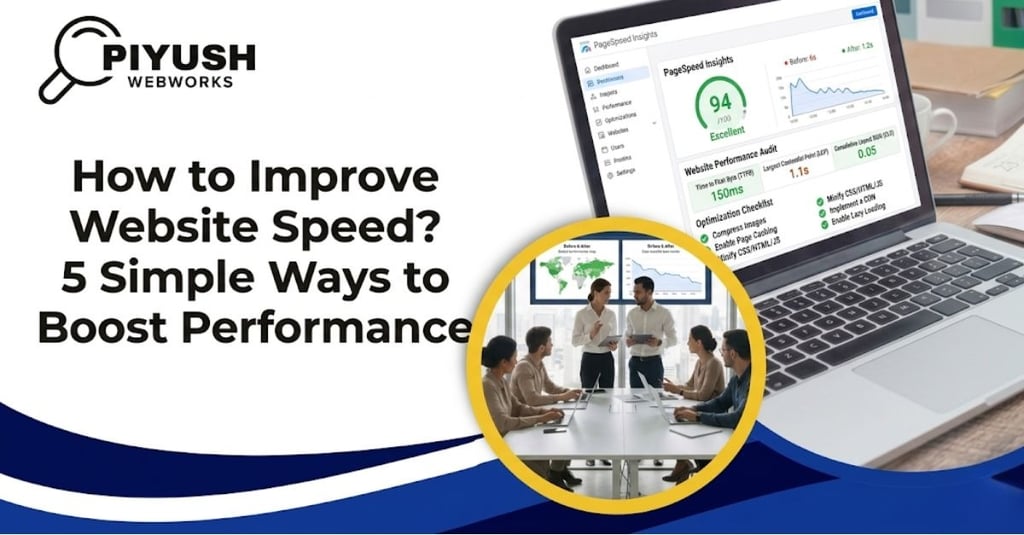

Most people immediately jump to technical solutions when considering site speed, servers, caching, and code minification. But here’s the truth: great website design itself plays a massive role in performance
A slow-loading site that has a beautiful design is not a good experience. On the other hand, a well-thought-out, lightweight website not only looks good but also feels fast.
So if you’re designing or redesigning a website, this guide will show you how to improve website speed through better design choices, not just backend tweaks.
Why Does Designing a Website Affect Speed?
Design is not only about graphics, but it has a direct impact on the speed of loading your site and on its performance
Slow layouts = slower load times
Excessive animations = slow experience
Google has also taken into account the Core Web Vitals, which are highly dependent on such a design choice as layout stability and visual loading speed.
In a nutshell: good design = fast design
1. Use Clean Design Layouts
Minimalism is not only fashionable, but it is also speedy. Crowded layouts that have excessive elements (sliders, popups, widgets) accelerate load time and negatively impact user experience.
2. Maximize Graphical Items
(Images, Icons, and Graphics)
Design is very dependent on graphics--but bad graphics are the greatest contributors to slow sites.
What to Do:
Use compressed pictures
Use SVG icons where heavy images are used.
Do not use full-screen background pictures unless optimized.
Apply responsive images to variants of screens.
Design Tip: Other than big decorative pictures, play with color blocks, gradients, or even minimal patterns; they appear contemporary and load quickly.
3. Restrict Size of Animations
Animations can turn a site into a high-quality one- but excessive animation can ruin the performance.
Common Mistakes:
Overusing scroll animations
Heavy JavaScript-based effects
Several animations simultaneously.
4. Select Friendlier Fonts and Typography
Typography is a fundamental aspect of design, but bespoke fonts are capable of slowing down the process unless managed correctly.
Best Practices:
Use optimized Google Fonts.
Restrict font families (up to 2-3)
Do not use too many font weights.
5. Mobile-First Performance Design
The majority of users nowadays use mobile devices. Unless you design your site to be mobile-friendly, it will be slow, even though it may be fast in technical terms.
What to Focus On:
Use responsive layouts
Don’t use big desktop-only elements
Maximize tap targets and interspacing.
Minimize content on smaller screens.
Why It Matters:
Mobile-first indexing is employed by Google, and as such, your mobile design has a direct influence on SEO rankings.
Design Decisions That Silently Hinder Speed
These mistakes are made even by experienced designers
Excessive number of plugins/builders.
Slow page generators with fat code
Unoptimized sliders
Carousels on each page.
It is always important to ask:
Does this design element add value?
Performance analysis tools:
Google PageSpeed Insights
GTmetrixtLighthouse (Chrome DevTools)
Final Thoughts
The speed of websites is not only the work of developers but begins with design. An effective website must :
load fastly
Feel smooths
Be easy to navigate
Appear untarnished and yet not solemn.
Intelligent design + performance optimization = a site that not only outranks but also gets visitors into customers.
Need to make a site that is not only beautiful, but also fast and light? You can be guaranteed that the correct team will make it. This is where Piyush Webworks comes in. They specialize in the creation of modern, performance-driven websites where design and speed should be considered as one, and assisting businesses to expand by delivering websites that perform.
A great site is not only viewed, but experienced.
Piyush Saini
Founder – Piyush Webworks
Piyush Saini is a website designer and online solutions expert who is enthusiastic about assisting companies in developing a powerful and successful Internet presence. He has collaborated with startups, local companies, and entrepreneurs to design professional websites to facilitate brand awareness, customer contact, and digital expansion. Being the Founder of Piyush Webworks, he is concerned with providing creative and performance-based web solutions that will enable businesses to achieve credibility in the competitive digital market.
In Piyush Webworks, he heads projects that are associated with Website Designing and development, SEO optimization, business website design, and Digital marketing support. His output revolves around creating responsive websites with user-friendly features and optimized for search engines to enhance user experience and assist a business in drawing more potential customers to its online platform.

Our Services


+91 8595685128
Copyright ©2026 All Rights Reserved
Designed By PIYUSH WEBWORKS
Quick Links
Copyright ©2026 All Rights Reserved