
How to Optimize Your Website for AI-Powered Search in 2026
WEBSITE DESIGNING
5/16/20266 min read
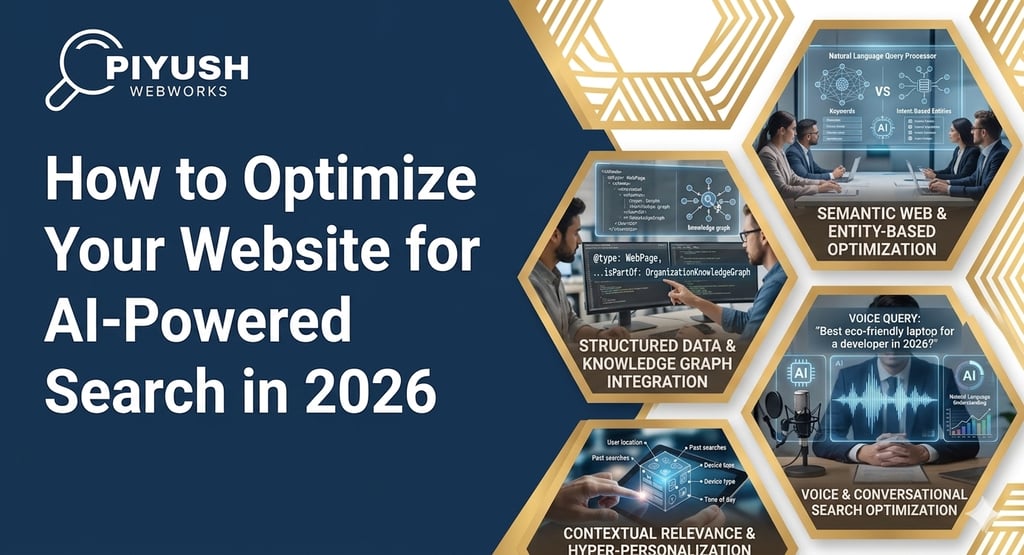
Google and other search engines are no longer just displaying blue links. AI-powered search engines such as Google AI Overviews, OpenAI ChatGPT Search, Perplexity AI, and Anthropic Claude are transforming how people find information on the internet in 2026.
Users no longer have to browse through a lot of search results; they will now receive instant answers generated by AI.
This change has totally revolutionized SEO.
Old and keyword-stuffed methods for ranking are becoming obsolete. The optimization of websites for search engines is not enough; today, their optimization for such an AI system that is able to summarise, cite, and recommend content to the user is also required.
In 2026, if you're looking for your site to remain discoverable, lead generation, and establish authority, you need to know about AI-powered search optimization.
In this blog, you will learn exactly how to do this practically to optimize your website for AI-powered search engines.
What Is AI-Powered Search?
Unlike traditional search methods, AI-powered search leverages artificial intelligence and large language models (LLMs) to comprehend user intent and provide direct answers rather than just website links.
Examples include:
Google AI Overviews
ChatGPT Search
Perplexity AI
Gemini AI
Claude AI
These websites analyze websites, provide a summary of the information, and display the best answer for users right away.
This isn't only about ranking anymore – now your website is competing for AI rankings and citations as well.
The Importance Of AI SEO In 2026
Search results generated by AIs are starting to be on display in a massive share of searches now. AI Overviews are proving to be very influential in informational queries, according to research.
Because of this:
The number of clicks coming from organic searches is on the decline.
More and more people are using “zero-click” searches.
AI summaries are taking the place of normal snippets.
It's more important than ever to have authority and trust.
Early adaptation of websites will bring great benefits.
1. Write Helpful Content and Human-First
There is a simple rule to SEO in 2026:
Write for people, not for robots.
AI search engines give priority to:
Useful information
Clear explanations
Real expertise
Original insights
Problem-solving content
Little-thumbed articles, those that are created just for the keywords, are not performing well these days. AI systems prefer having a lot of high-quality information that is accurate.
Best Practices
i. Use simple language to write in the text.
Write in simple words, simple sentences, and use simple formatting.
ii. Answer questions directly
Content that addresses user queries is popular with AI models.
For example:
Instead of:
As a business, SEO is one of the essential marketing strategies that you adopt.
Write:
SEO improves the rank of websites on search engines and brings lots of visitors to them.
iii. Use real examples
Include case studies, experiences, screenshots, and/or practical tips if possible.
2. Deliver Original Content
With AI-powered search, it's about going beyond keywords towards understanding intent.
Search intent - knowing what the user is searching for.
AI systems like pages that completely meet the purpose of the query.
How to Optimize
Identify the true needs of the users.
Discuss the needs of the users with analysis.
Create complete answers
Include FAQs
Cover related subtopics
Include comparisons as appropriate
3. Create Signals of Strong E-E-A-T
E-E-A-T stands for:
Experience
Expertise
Authoritativeness
Trustworthiness
These signals are crucial to Google and AI systems when determining sources.
Include:
Author bio
Experience
Credentials
Social profiles
Show Real Experience
Share:
Personal insights
Original research
Client results
Practical knowledge
AI search engines favor new and up-to-date information.
4. Use Structured Data and Schema Markup
With schema markup, AI systems can better comprehend your content.
It is sort of a map for search engines.
AI SEO research indicates that structured data is gaining significant importance in AI-driven search results. Several AI SEO reports suggest that structured data is increasingly playing a crucial role in AI-generated search results.
In 2026, we will have some important schema types to consider.
Article Schema
FAQ Schema
HowTo Schema
Breadcrumb Schema
Organization Schema
Local Business Schema
Benefits of Schema
Better AI understanding
Improved visibility
Enhanced search appearance
Improved likelihood of AI citations.
5. Improve for Less Conversational Queries
Nowadays, people search differently due to AI assistants.
Instead of typing:
“best seo tools”
Users ask:
So, what are the top SEO tools for small businesses in 2026?
Your content should be relevant to conversational queries.
How to Do This:
i. Add FAQ Sections
Be able to answer the actual user's questions naturally.
ii. Use Long-Tail Keywords
Don't do keyword stuffing with a robotic approach.
6. Improve Technical SEO
Technical SEO is still important in 2026.
AI systems might not pay attention to a website if it is slow and/or difficult to crawl.
Fast websites improve:
User experience
Crawlability
Rankings
Mobile Optimization
Clean Site Structure
Use:
Clear URLs
Proper headings
Internal linking
Organized navigation
HTTPS Security
Secure Websites build trust.
7. Create Topic Clusters
AI systems, like websites that have topical authority. Rather than creating random blogs, develop a group of blogs about the topic.
Example
Main Topic:
“AI SEO”
Supporting Blogs:
AI Overviews optimization
GEO vs SEO
AI content strategy
Schema markup guide
AI search trends
This lets AI know that your website is the authority site for that niche.
8. Work on the AI Citations
With AI search, citations are more important than rankings. AI systems retrieve data from sites that it is familiar with and trust. How to make AI more visible
Add Statistics
AI systems gravitate toward content that is based on facts and data.
Use Bullet Points and Tables
Use structured formatting for enhanced readability.
Write Concise Answers
AI systems can more easily pull the necessary pieces of information out of direct answers.
Use Multimedia Content
The inclusion of multimedia content is becoming more crucial for AI search engines.
Add:
Images
Infographics
Videos
Charts
Interactive elements
Visual content improves:
Engagement
Time on site
User experience
It also boosts the likelihood of showing up in the visual AI search results.
Strengthen Brand Authority
Brand recognition is making an impact as a ranking factor in AI search.
AI systems have a greater level of trust with recognisable and believable brands. Establish yourself as an expert in your field.
How to become a brand authority:
i. Maintain Consistent Branding
Use the same:
Logo
Brand voice
Business information
Be Active on multiple platforms
Build presence on:
LinkedIn
YouTube
Instagram
Industry websites
encourage reviews and mentions.
Trust signals are enhanced with positive reviews.
ii. Improve for Local AI SEO
Local businesses need to optimize for local search as well, but this time with AI.
Several important strategies are important to SEO:
Set up and optimize Google Business Profile.
Add local keywords
Collect customer reviews
Use LocalBusiness schema
Keep up-to-date NAP information
Local trust signals can often be a deciding factor in AI search engine rankings.
iii. Ensure the Performance of AI Search.
Just using the traditional metrics of SEO is no longer sufficient.
At this point, it is advisable to monitor:
AI citations
Brand mentions
Visibility in AI Overviews
Conversational query performance
Zero-click traffic impact
AI search is a rapidly changing field, and it is crucial to monitor it regularly.
iv. Don’t Ignore Traditional SEO
There are many marketers who believe that AI SEO has completely replaced traditional SEO.
That’s not true.
Google has itself suggested that there is a place for good old SEO practices when it comes to AI.
You still need:
Quality backlinks
Good content
Technical SEO
Strong user experience
Proper indexing
AI SEO is more effective when used in conjunction with traditional SEO methods.
Common Mistakes to Avoid When Using AI for SEO
i. Keyword Stuffing
Too many keywords will create an unnatural appearance of content.
ii. Publishing Thin Content
Very short and lower-value articles don't do so well.
iii. Ignoring User Experience
Every poor design and slow loading has an impact on rankings.
The Future of AI-Powered Search
AI search is continually changing and developing.
Experts predict:
More conversational search
Personalized AI answers
Fewer traditional clicks
Stronger attention to leadership.
Those businesses that are ready to adapt early will be the ones that will be visible in the future.
Final Thoughts
AI search is no longer a future reality; it's already here.
In 2026 and beyond, those websites that offer real value, good technical SEO, topical authority, structured content, and trust will succeed.
Rather than getting into the “game” of algorithms, make yourself the best information source in your field. AI systems are becoming more and more intelligent by the day, and they're giving websites back credit for helping their users.
For expert advice on optimizing your website for AI-powered search, SEO, content marketing, and digital growth, Piyush Webworks can help you future-proof your website with AI-forward SEO techniques.
From startup ventures to local businesses or e-commerce companies, any business that can benefit from AI SEO today is likely to stand out in the race tomorrow.
Piyush Saini
Founder – Piyush Webworks
Piyush Saini is a website designer and online solutions expert who is enthusiastic about assisting companies in developing a powerful and successful Internet presence. He has collaborated with startups, local companies, and entrepreneurs to design professional websites to facilitate brand awareness, customer contact, and digital expansion. Being the Founder of Piyush Webworks, he is concerned with providing creative and performance-based web solutions that will enable businesses to achieve credibility in the competitive digital market.
In Piyush Webworks, he heads projects that are associated with Website Designing and development, SEO optimization, business website design, and Digital marketing support. His output revolves around creating responsive websites with user-friendly features and optimized for search engines to enhance user experience and assist a business in drawing more potential customers to its online platform.

Our Services


+91 8595685128
Copyright ©2026 All Rights Reserved
Designed By PIYUSH WEBWORKS
Quick Links
Copyright ©2026 All Rights Reserved