
SEO for Shopify: The Ultimate Guide to Higher Rankings (2026)
SEO
4/22/20264 min read
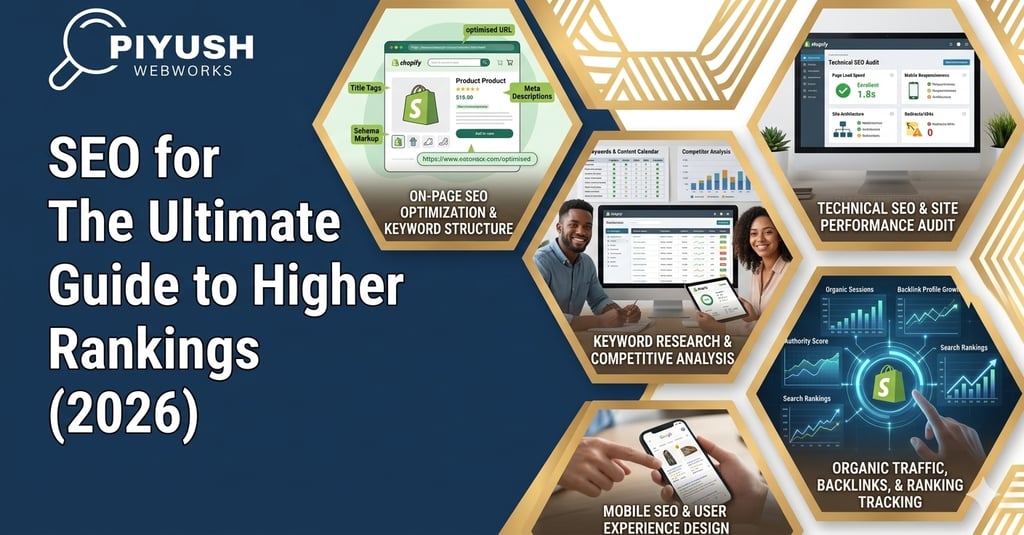
You may find yourself asking why your products are not appearing on Google, and you are not alone, especially when you have a Shopify store. One of the most effective methods to attract free, high-converting traffic to your shop is SEO with Shopify.
In contrast to paid ads, SEO is long-term--it attracts regular visitors who are actively seeking what you sell. Search engines are actually amongst the largest online discovery sources, and thus, a vital element in growth is SEO.
We will break down, in an easy, practical, and result-oriented manner, everything you need to know in bits.
What does Shopify SEO mean?
The process of making your online store appear higher in search engines such as Google is known as Shopify SEO.
It includes:
Optimizing product pages
Improving website structure
Applying the appropriate keywords.
Building backlinks
Enhancing user experience
The goal:
Appear higher on search engine results pages (SERPs).
Get more organic traffic
Increase sales
A higher ranking will result in increased visibility, and the highest ranking results will receive most of the clicks.
Why Shopify SEO is Important?
This is why you should not disregard SEO:
1. Free Traffic (No Ads Needed)
SEO attracts free traffic without advertisements.
2. High Intent Audience
Individuals on the search are already interested in purchasing.
3. Long-Term Growth
SEO does not cease to work after you have stopped spending, as in the case of ads.
4. Better Brand Credibility
The higher the rankings, the more trust.
Shopify SEO: How it works?
The search engines rank your store depending on several important factors:
Keyword relevance
Content quality
Backlinks
Website structure
User experience
Let us divide each into steps:
1. The Foundation Keyword Research
It all begins with keywords.
Types of Keywords to which you should aim:
Product keywords → black hoodie for men.
Keywords as categories → men's winter wear.
Informational keywords → how to style hoodies.
Pro Tips:
Use long-tail (less competition, greater conversion) keywords.
Target buyer intent keywords.
Avoid keyword stuffing
Example:
Instead of
“Shoes”
Use
Women's comfortable running shoes.
2. Shopify On-Page SEO
This is where the majority of the stores lose or win.
Optimize These Elements:
✔ Title Tags
Include the main keyword
Make it simple and accessible.
✔ Meta Descriptions
Add keywords + CTA
Improve click-through rate
✔ URL Structure
Clean and keyword-rich
Example:
/black-cotton-hoodie-men
✔ Headings (H1, H2, H3)
Use keywords naturally
✔ Image Alt Text
Helps Google is aware of images.
Improves visibility
All these elements can be easily edited using Shopify.
3. Product Page Optimization
Your money-makers are your product pages.
Make Them SEO-Friendly:
Write product descriptions (not duplicated).
Add FAQs
Deliver value and not features.
Use keywords naturally
4. Optimize Collection Pages
The majority of people overlook this- a great error.
What to Do:
Include a brief explanation (100-300 words)
Use keywords naturally
Association with related products.
Collection pages assist Google in comprehending your store's arrangement.
5. Shopify Technical SEO.
Built-in SEO Features:
Sitemap.xml
Robots.txt
SSL security
Canonical tags
Still, You Should:
Improve site speed
Fix broken links
Avoid duplicate URLs
Optimize mobile experience
6. Internal linking and Structure of the site.
Imagine your website as a map.
Best Practices:
Broad categories- subcategories- products.
Associate blogs with products.
Associate collections with products.
Internal interconnection assists search engines in crawling your site more efficiently, and enhances ranking.
7. Content Marketing (Game-Changer)
If you’re not blogging, you’re missing out.
Why Blogging Works:
Targets informational keywords
Brings top-of-funnel traffic
Builds authority
Blog Ideas:
“Top winter clothes for men.
The best suggestions on how to select the ideal hoodie.
“Top fashion trends 2026”
SEO is not simply about products, but it is about assisting the users.
8. Backlinks (Authority Builder)
Backlinks = other websites that are linked to you.
The more backlinks, the more trust and the higher the rankings.
How to Build Them:
Guest blogging
Influencer collaborations
Directory listings
Shareable content
Backlinks are considered votes of confidence by search engines.
9. User Experience (UX Matters A LOT)
Google monitors the activities of users on your site.
Improve UX:
Fast loading speed
Mobile-friendly design
Easy navigation
Clear layout
Rankings decline in case users are leaving at any time.
SEO Errors to Stay Away From in Shopify
We can save you months of struggle.
Common Mistakes:
Duplicate content
Ignoring collection pages
No blog strategy
Slow site speed
Keyword stuffing
Poor internal linking
Reality check:
Most of the Shopify stores are preoccupied with advertisement and design, forgetting the basics of SEO that can generate growth.
Shopify SEO in 2026: Advanced Strategies (2026)
Wish to take it to the next level? Try this:
✔ Topic Clusters
Develop one central guide and several related blogs.
✔ Optimize for Featured Snippets.
Answer questions directly
✔ Target Low-Competition Keywords
Rankings that are easier and quicker.
✔ target Pages that are almost ranking.
Enhance pages that are on page 2.
Shopify SEO Checklist (Quick Recap)
The following is your plan of action:
✔ Keyword research
✔ Optimize product pages
✔ Improve collection pages
✔ Fix technical SEO
✔ Build backlinks
✔ Start blogging
✔ Improve site speed
✔ Emphasize user experience.
SEO with Shopify is a Long Game
Being honest, SEO does not happen overnight.
New sites: 6–12 months
Existing sites: 2-3 months to make improvements.
But when it begins to operate.
Traffic grows
Sales increase
Ads dependency reduces
Conclusion
SEO is not something you do just in case you want to scale your Shopify store; it is a must.
But with this, however, there is a thing:
It takes strategy, consistency, and expertise to do SEO.
Professional assistance can be of great help there.
Piyush Webworks can help you:
Boost your Shopify store to be ranked higher.
Organic traffic driven.
Improve conversions
Develop long-run expansion plans.
You do not have to guess what to do, but use a proven SEO system specific to your business niche and requirements.
Piyush Saini
Founder – Piyush Webworks
Piyush Saini is a website designer and online solutions expert who is enthusiastic about assisting companies in developing a powerful and successful Internet presence. He has collaborated with startups, local companies, and entrepreneurs to design professional websites to facilitate brand awareness, customer contact, and digital expansion. Being the Founder of Piyush Webworks, he is concerned with providing creative and performance-based web solutions that will enable businesses to achieve credibility in the competitive digital market.
In Piyush Webworks, he heads projects that are associated with Website Designing and development, SEO optimization, business website design, and Digital marketing support. His output revolves around creating responsive websites with user-friendly features and optimized for search engines to enhance user experience and assist a business in drawing more potential customers to its online platform.

Our Services


+91 8595685128
Copyright ©2026 All Rights Reserved
Designed By PIYUSH WEBWORKS
Quick Links
Copyright ©2026 All Rights Reserved