
Top Website Design Trends Businesses Must Follow in 2026
WEBSITE DESIGNING
5/7/20266 min read
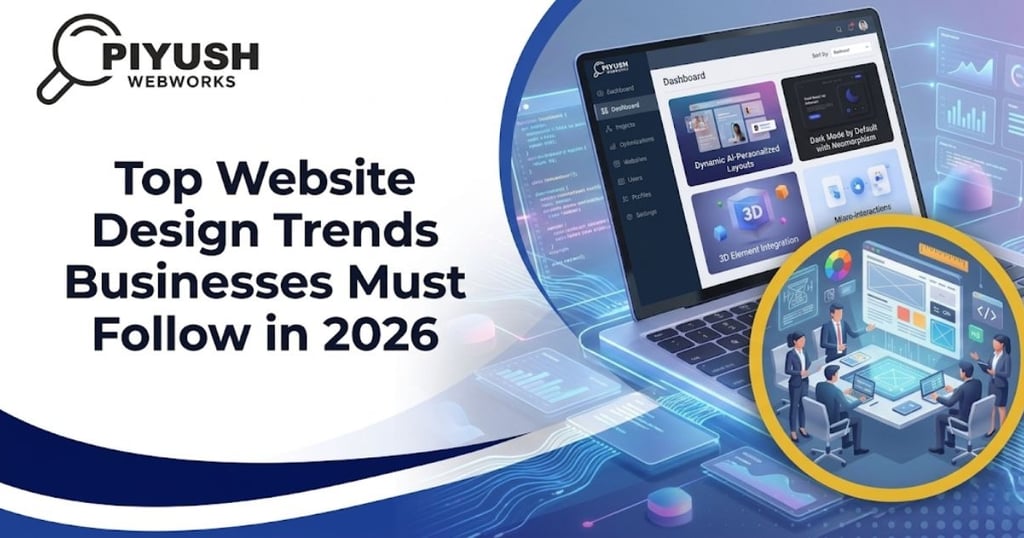
Your website is the first impression customers have in today's digital age. If a business has a modern, fast, and easy-to-use website, then it can build trust, acquire leads, and boost sales. As technology evolves rapidly, website design trends are also changing faster than ever.
For 2026, companies are prioritizing user experience, mobile-friendliness, AI-driven personalization, speed optimization, and eye-catching design. From startups to E-Commerce websites, from agencies to local businesses, staying up to date on the latest website design trends can be a significant competitive edge.
In this blog, we will see the Website Design trends that businesses need to pay attention to in 2026 to keep their websites relevant in the digital world.
Why Website Design Matters More Than Ever
Your website is no longer a virtual brochure. It has become a powerful marketing and branding tool. These days, users are expecting websites to load quickly, be visually appealing, and function seamlessly on all devices.
Good website design can assist businesses in:
Improve user experience
Increase customer trust
Generate more conversions
Improve Google rankings
Reduce bounce rates
Strengthen brand identity
If your website isn't designed properly, your visitors will be gone in less than 10 seconds. Hence, modern web design trends in 2026 are a big investment for businesses.
1. AI-Powered Website Experiences
Artificial Intelligence is transforming website design in 2026. AI tools are now helping businesses personalize user experiences and make websites more interactive.AI tools are now helping to personalize user experiences and making websites smarter.
AI-powered websites can:
Represent products in response to user behavior
Show personalized content
Utilize AI chatbots to provide immediate assistance.
Analyze customer data
Improve user engagement
Businesses can meet their conversion and customer satisfaction goals with AI-driven personalization. Several brands are adopting smart automation, creating a more interactive and efficient application.
2. Minimalist and Clean Website Layouts
The trend of minimalism is still in effect for modern website design. It is time for businesses to leave cluttered pages and move towards simplicity.
Typically, a minimalist website contains the following elements:
Clean typography
Simple color palettes
More white space
Easy navigation
Clear call-to-action buttons
Clean design ensures that information is more easily understood and that users can focus on what is most important. It also helps to establish a high-quality and professional brand image.
With Minimalist Design, the advantages are:
Faster loading speed
Better user experience
Improved mobile responsiveness
Higher conversion rates
3. Dark Mode Design
Dark mode continues to be one of the most popular website design trends in 2026. Dark interface designs are popular because they are modern and put less strain on the eyes.
Companies are providing a dark mode choice for:
Better accessibility
Stylish appearance
Better night visibility.
Enhanced visual contrast
Dark Mode is particularly useful for:
Tech companies
Creative agencies
Gaming websites
Portfolio websites
It not only enhances readability but also contributes to a sleek and stylish design with the help of neon accents and contemporary typography.
4. Bento Grid Layouts
Bento grid layouts have grown to be extremely popular in web design today. The concept of "bento" originated in Japan, where it involves creating a visually organized structure of information.
Major brands and startups are using bento layouts because they:
Improve content organization
Create user-friendly websites
Design appealing websites.
Highlight important sections
Improve mobile adaptability
Bento boxes are ideal for:
SaaS websites
Tech startups
Portfolios
Agency websites
It is a layout style that provides a clean and very interactive appearance to websites.
5. Advanced Micro-Interactions
Micro-interactions are subtle animations or visual effects that users encounter when they are interacting with a website.
Examples include:
Hover animations
Button effects
Loading animations
Scroll-triggered movements
Interactive icons
These minute touches add to the appeal and drive engagement with websites, making them more dynamic and high-quality.
In 2026, small businesses are leveraging micro-interactions to:
Guide users smoothly
Improve navigation
Extend the duration of time spent on the website
Extend the length of time on the website.
Create memorable experiences
Designers have to utilize them with care, however, to not negatively affect their sites' performance.
6. Mobile-First Website Design
Mobile-first designing is no longer an option. Over 70% of people now use their mobiles to surf websites.
Also, Google will rank mobile-friendly websites. The reason it is a major focus for businesses in 2026 is that responsive web design is vital to their success.
A mobile-first website has:
Responsive layouts
Fast loading speed
Easy navigation
Touch-friendly buttons
Optimized images
In many cases, businesses with substandard mobile experiences end up losing their customers in no time. The website must be responsive to be successful in terms of SEO and conversions.
7. Fast Website Speed and Performance Optimization
The speed of a website directly impacts both user experience and search engine optimization.
Users who use the modern web demand websites to load within seconds. Slow websites lead to high bounce rates and low conversion rates.
Companies are focusing on:
Lightweight design
Optimized images
Fast hosting
Lazy loading
Clean coding structures
Google’s Core Web Vitals are also playing a major role in SEO rankings. Not only do faster websites rank higher, but they also help to increase customer satisfaction.
Website speed optimization tips:
Compress images
Use caching
Reduce unnecessary plugins
Optimize scripts
Choose reliable hosting
8. Immersive 3D Elements and Motion UI
Today's websites are getting more interactive, featuring 3D graphics and animation.
Brands are using:
3D product displays
Interactive animations
Scroll-based storytelling
Motion graphics
Dynamic transitions
These capabilities enable businesses to develop distinctive digital experiences.
In particular, 3D design is on the rise in the following areas:
Fashion websites
Tech companies
Creative agencies
Product showcase websites
If implemented appropriately, visuals can play an important role in engagement.
9. Accessibility-First Website Design
In the current web design, accessibility has emerged as one of the key areas of focus.
Web businesses are realizing the significance of accessibility for their site and for people with impairments.
Accessibility-focused websites include:
Proper color contrast
Screen reader support
Keyboard navigation
Alt text for images
Readable typography
Inclusive websites not only enhance inclusivity but also contribute to their SEO performance.
Google favors websites that offer more user-friendly experiences for all visitors.
10. Voice Search Optimization
As smart assistants such as Alexa, Siri, and Google Assistant are gaining popularity, so is voice search.
Companies are fine-tuning websites for voice search by:
Using conversational keywords
Improving page speed
Creating FAQ sections
Optimizing local SEO
Voice-friendly websites are excellent for businesses to engage with their customers who are looking up information from their smartphones and smart devices.
This trend is likely to continue to increase in the future.
11. Personalized User Experiences
Today's customers want a personalized experience when they're online.
Data-driven website personalization is being utilized by businesses to:
Recommend products
Display targeted content
Show personalized offers
Improve customer journeys
Customers are more likely to return to a personalized website, and this boosts engagement.
In 2026, AI and automation tools will support brands to deliver highly personalized website experiences.
12. Sustainable and Eco-Friendly Web Design
The Digital World is increasingly going green.
Companies are turning to green website techniques like:
Lightweight designs
Efficient coding
Optimized servers
Reduced energy consumption
Not only that, but a sustainable site performs better and is socially responsible branding.
With increased environmental awareness, green web design is becoming more common all over the world.
13. Typography-Focused Design
Typography has become more of a presence in today's website aesthetics.
Brands are making stronger visual identities with large, bold fonts, creative typography, and clean text layouts.
Recent typography patterns are:
Oversized headings
Minimal text sections
Custom fonts
High readability
Dynamic typography animations
An effective typography enhances the users' attention and the website's aesthetics.
14. Interactive Storytelling Websites
Interactive storytelling is one of the most interactive web design trends of 2026.
Businesses are using:
Scroll animations
Visual storytelling
Interactive transitions
Motion graphics
These elements enable brands to emotionally engage users and to convey information innovatively.
This trend is particularly strong for:
Brand storytelling
Product launches
Creative portfolios
Startup websites
15. SEO-Friendly Website Architecture
Nowadays, websites are created with SEO as a top priority.
Websites that have been optimized for search engines have the following features:
Clean URL structures
Fast page speed
Mobile responsiveness
Internal linking
Optimized headings
User-friendly navigation
If your site looks great but has no SEO, then it may not get any traffic.
As businesses realize that design and SEO go hand-in-hand, they are stitching them together to yield both ranking and conversion benefits.
What Businesses Need to Do to Stay Ahead in 2026
To remain competitive, enterprises should:
Update a website design on a regular basis.
Prioritize user experience.
Improve website speed
Prioritize mobile responsiveness
Leverage AI tools strategically
Optimize for SEO
Simplify designs and use modern design elements.
One of the most important investments that a business can make in 2026 is a modern website.
Final Thoughts
In 2026, web design trends are all about making digital experiences smarter, faster, more engaging, and user-friendly. By keeping up with the current trends in web design, businesses can build customer trust, enhance conversions, and gain a competitive edge.
The future of web design is interactive, performance-driven, and more interactive than ever, with AI being the cornerstone of personalization, minimal design, mobile-first approach, and immersive experiences.
Working with professionals well-versed in their field can be a significant help if you're looking to redesign your website or create a modern business website design that's up-to-date with the latest trends.
If you're seeking modern web solutions, SEO optimized websites, and conversion-focused websites, Piyush Webworks is the solution that can help you.
Piyush Saini
Founder – Piyush Webworks
Piyush Saini is a website designer and online solutions expert who is enthusiastic about assisting companies in developing a powerful and successful Internet presence. He has collaborated with startups, local companies, and entrepreneurs to design professional websites to facilitate brand awareness, customer contact, and digital expansion. Being the Founder of Piyush Webworks, he is concerned with providing creative and performance-based web solutions that will enable businesses to achieve credibility in the competitive digital market.
In Piyush Webworks, he heads projects that are associated with Website Designing and development, SEO optimization, business website design, and Digital marketing support. His output revolves around creating responsive websites with user-friendly features and optimized for search engines to enhance user experience and assist a business in drawing more potential customers to its online platform.

Our Services

+91 8595685128
Copyright ©2026 All Rights Reserved
Designed By PIYUSH WEBWORKS
Quick Links
Copyright ©2026 All Rights Reserved