
What Is a Multimodal Content Strategy and How to Build It (5-Step Guide)
CONTENT MARKETING
5/25/20265 min read
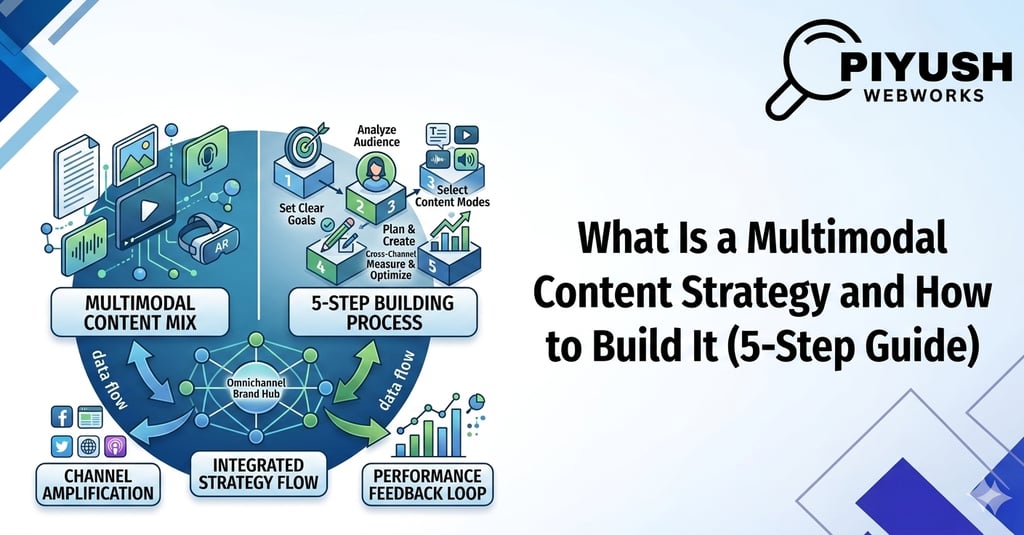
The era of producing just blog posts or just social media posts is over in today's digital age. There are various ways that people interact with content, such as reading blogs, watching videos, listening to podcasts, scrolling through a carousel, or engaging with an infographic. Here's where a multimodal content strategy is important.
Brands need multiple content formats to reach a wider audience, engage more followers, improve SEO rankings, and increase online visibility. If you are a business owner, a marketer, a startup, or an agency, there is a chance that you know how to grow your brand faster in 2026 and beyond by knowing what multimodal Content Marketing is.
What is a Multimodal Content Strategy?
Multimodal Content Strategy is a marketing concept that involves delivering a message across multiple modalities/media.
Brands don't just use one type of content; they use a mix of formats, such as:
Blogs
Videos
Podcasts
Infographics
Social media posts
Reels and shorts
Emails
Case studies
Webinars
Interactive content
The objective is straightforward: send the same message in various formats to be consumed easily.
For example:
One blog post can be:
An Instagram carousel
A YouTube video
A LinkedIn post
An email newsletter
A podcast discussion
A short reel
This method helps to reach content without too much effort in creating content from scratch.
The Importance of Multimodal Content Strategy in 2026
The world of digital marketing is changing fast. Now, search engines, social networks, and AI-powered systems favor rich and engaging content experiences.
Google and AI search engines favor content that:
Keeps users engaged
Delivers information in a variety of ways
Answers questions clearly
Improves user experience
Because brands with multimodal content tend to do better in:
SEO rankings
User engagement
Brand awareness
Lead generation
Social media growth
Flexibility is also a requirement that consumers have. Some aren't going to read an extended piece of content but will be happy to view a 60-second video or reel about the same subject.
Benefits of a Multimodal Content Strategy
Improves SEO Performance
Good and interesting content is a search engine's favorite. Incorporating videos, photos, infographics, and interactive features can:
Reduce bounce rate
Improve rankings
Generate backlinks
Multiple formats also help in targeting more keywords organically.
Connects with Various Types of Audiences
All users read in their unique ways.
Some people:
Likes reading long articles or blogs
Use videos to break up tasks during the breaks.
Listen to podcasts on the way to work.
Store infographics for future use.
A multimodal approach enables you to reach them all.
Increases Content Lifespan
Don't publish one blog and forget it; you can repurpose it in a multitude of ways.
This saves:
Time
Budget
Effort
A great content idea can support your marketing efforts for weeks.
Boosts Engagement on Social Media
Typically, short-form visual content works well in social platforms.
To convert your long-form content into:
Reels
Carousels
Shorts
Visual snippets
Can greatly enhance engagement and shares.
Increased the Brand's Authority
Your brand is seen by users across blogs, YouTube, LinkedIn, Instagram, and emails, making it look more trustworthy and professional. A consistent brand across platforms enhances brand recall.
The items in a multimodal strategy can include:
These are the most frequent types of content that businesses use today:
Blog Content
Articles written for search engine optimization – ranking in the search engines.
Video Content
Explainer videos, tutorials, webinars, interviews, and reels.
Social Media Content
Posts, stories, memes, threads, carousels, and shorts.
Audio Content
Audio blogs, podcasts, and voice discussions.
Visual Content
Infographics, graphics, charts, branded graphics, and illustrations.
Interactive Content
Polls, quizzes, calculators, and interactive tools.
Email Marketing Content
Newsletters, updates, promotions, and lead nurturing emails.
How to Build a Multimodal Content Strategy (5-Step Guide)
Step 1: Understand Your Audience
The first step is knowing:
Who your audience is
What they need
Which platforms do they use
How they eat content.
How they digest their content.
Ask questions like:
Are they more of a visual learner, or do they like reading blogs?
What are their social media?
What are their problems?
For busy professionals, shorter videos and LinkedIn posts might do better than longer podcasts.
Tools to use:
Google Analytics
Google Trends
Instagram Insights
YouTube Analytics
SEMrush
Ahrefs
Once you understand the behaviours of your target audience, you can create content that fits into their preferred formats.
Step 2: Create One Core Content Piece
Don't create random content every day – begin with one “pillar” content piece.
This can be:
A long blog
A webinar
A podcast episode
A case study
This is the primary piece of content you have.
Example:
Let's assume that your topic is:
“SEO Trends in 2026”
Make it into:
Blog article
Instagram carousel
YouTube explainer
LinkedIn post
Email newsletter
Twitter thread
Short reels
This is referred to as content repurposing.
Step 3: Repurpose Content Across Platforms
The heart of a multimodal strategy. The thing is to adjust the same message for different platforms rather than copy and paste.
Important Tip: Users' minds differ across platforms.
For example:
Users of LinkedIn are more interested in professional insights.
Instagram is a platform where users love to see content as stories. Instagram people appreciate visual storytelling.
YouTube viewers want explanations.YouTube watchers want explanations.
Step 4: Optimize All Content Formats for SEO
Blogs are not the only places where SEO will fit in.
You should optimize:
Video titles
Image alt text
Podcast descriptions
Social captions
Meta descriptions
Hashtags
Step 5: Monitor Results and Make Improvements
It is important to continuously improve content for a successful content strategy.
Track metrics like:
Website traffic
Engagement rate
Watch time
Shares and saves
Leads generated
Conversion rates
Bounce rate
Useful Analytics Tools:
Google Analytics
Search Console
Meta Insights
HubSpot
Hotjar
YouTube Studio
Identify:
Which is the best format?
Which platform offers traffic?
What type of content is responsible for conversions?
Then fine-tune your future strategy from the actual numbers.
The Best Tools for Multimodal Content Creation
These are some tools which marketers use:
Content Writing Tools
Grammarly
ChatGPT
Jasper
Design Tools
Canva
Adobe Express
Figma
Video Editing Tools
CapCut
Premiere Pro
DaVinci Resolve
SEO Tools
Ahrefs
SEMrush
Ubersuggest
Social Media Scheduling Tools
Buffer
Hootsuite
Later
Common Mistakes You Should Avoid
Posting the Same Content Everywhere
Every platform must be customized. Don't duplicate the same caption or format in all of your content.
Ignoring SEO
But even amazing content can not succeed if it's not optimized. Use keywords wisely and effectively.
Only Focus on Quantity
It is not a good long-term strategy to post every day without high-quality content. Create useful and informative material.
Not Repurposing Content
There is a lot of wasted time in which businesses, instead of reusing powerful existing content, create new content.
Ignoring Analytics
Without tracking performance, you won’t know what’s working. It is crucial to make data-driven improvements.
Future of Multimodal Content Marketing
Digital marketing is getting more interactive and AI-powered in the future.
Some of the trends in multimodal content are:
AI-generated content
Voice search optimization
Interactive videos
Personalized experiences
Visual search
Short-form videos
AI search engines
Cross-platform storytelling
Those brands that adopt early will have an advantage.
Final Thoughts
In 2026, the need for a multimodal content strategy is no longer a choice; it's a necessity for businesses aiming to thrive in the digital landscape.
Brands can use a blend of blogs, videos, social media, visuals, email, and interactive content to:
Reach wider audiences
Improve SEO rankings
Increase engagement
Build authority
Generate more leads
The best strategy is to come up with one great idea and adapt it into several different forms that can be utilized across various platforms.
A highly effective and SEO-driven multi-modal content strategy will benefit your business; having an expert team will help streamline the process. Piyush Webworks aids businesses in growing via SEO, website development, content marketing, branding, and digital growth strategies tailored for contemporary search and AI-powered platforms.
Piyush Saini
Founder – Piyush Webworks
Piyush Saini is a website designer and online solutions expert who is enthusiastic about assisting companies in developing a powerful and successful Internet presence. He has collaborated with startups, local companies, and entrepreneurs to design professional websites to facilitate brand awareness, customer contact, and digital expansion. Being the Founder of Piyush Webworks, he is concerned with providing creative and performance-based web solutions that will enable businesses to achieve credibility in the competitive digital market.
In Piyush Webworks, he heads projects that are associated with Website Designing and development, SEO optimization, business website design, and Digital marketing support. His output revolves around creating responsive websites with user-friendly features and optimized for search engines to enhance user experience and assist a business in drawing more potential customers to its online platform.

Our Services


+91 8595685128
Copyright ©2026 All Rights Reserved
Designed By PIYUSH WEBWORKS
Quick Links
Copyright ©2026 All Rights Reserved