
What is Responsive Web Design? Key Benefits and Best Practices Explained(2026 Guide)
WEBSITE DESIGNING
4/4/20264 min read
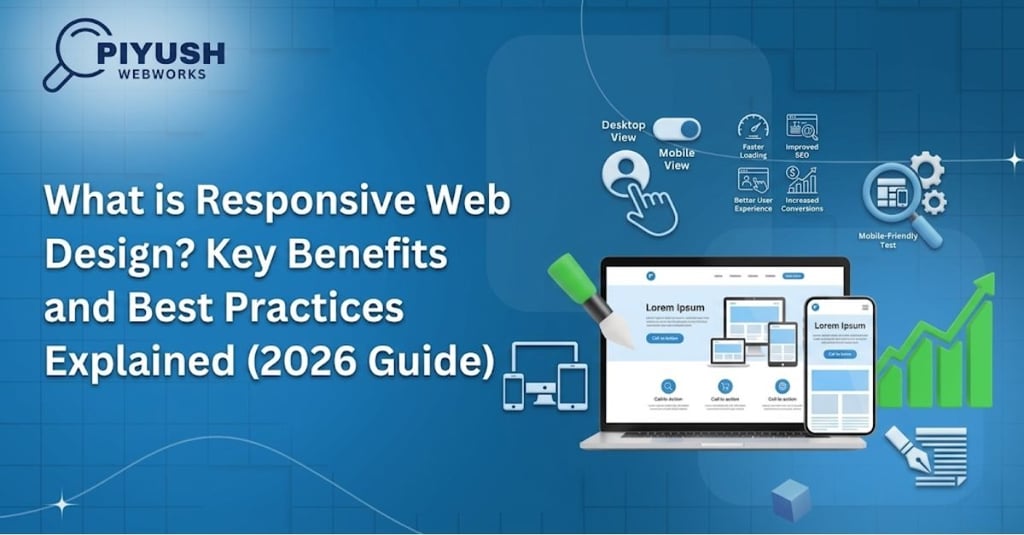
Responsive web design is what all businesses need in modern times, which is rapidly turning digital. As customers visit your site on smartphones, tablets, and desktops, your site should fit perfectly across different screen sizes.
A mobile-friendly site not only enhances user experience, but it is also significant for a better ranking in Google.
This blog will explain:
What a responsive web design is,
The advantages of a responsive web design,
and how to design a responsive website to achieve a high-performing website.
What is responsive web design?
Responsive Web Design (RWD) is a web design strategy that will automatically make your site change its format, pictures, and content based on the size of the device size.
Rather than developing individual websites, in responsive website design, the following are used:
Flexible grids
Fluid images
CSS media queries
This renders your website search engine friendly, user-friendly, as well as being mobile compatible.
Obviously, it is important to note why Responsive Web Design is Important in SEO.
Google has been using mobile-first indexing, and thus, the mobile version of your site is ranked higher.
Mobile-friendly site assists in:
Improved searching and indexing.
Better design of the user experience.
Reduced bounce rate
Faster website optimization
That is why the search engine optimization of web design can be directly correlated with the responsive design.
Advantages of Responsive Web Design
1. Enhanced User Experience (UX)
Everything is the users' experience.
A responsive website helps in:
Alteration of content to make it easy to read.
Gets rid of the problem of zooming and scrolling.
Enhances navigation
2. Better SEO Performance
Google favors websites that are friendly to mobile applications.
Responsive design helps:
Improve search rankings
Reduce bounce rate
Increase dwell time
This directly has an effect on your ranking in search results.
3. Cost-Effective Solution
Instead of building:
A desktop website
A mobile version
You have a single dynamic site that will save on time and developmental expenses.
4. Increased speed of loading the websites
The websites are responsive and are performance optimized when:
Quick loading on mobile devices.
Increased scores in page speed.
And there is speed--a great ranking factor.
5. Higher Conversion Rates
In cases where the users find it easy to navigate and communicate. They will have better chances of taking probable action
It does not matter whether it is buying or completing a form. The pleasant experience will result in improved conversions.
6. Easier Website Management
It is far easier to control a single site as opposed to several versions:
Easy updates
Consistent design
Less maintenance
Making a responsive web design: Best practices (2026)
The best strategies to use to come up with a high-performing responsive site are as follows:
The first design principle is to apply the Mobile-First Design Approach
One should start designing small screens and then scale to large screens. The following are the reasons for it:
The mobile traffic has increased.
Gives priorities to important content.
Adopt Fluid Grid Structures
Fixed pixel widths are substituted with percentage-based widths.
This gives your layout the ability to:
Adapt dynamically
Keep uniformity between the machines.
Image and Media Optimisation
Large pictures slow down your website. Try using:
Compressed images
Scalable formats (such as SVG).
Lazy loading
This enhances the performance and user experience.
Use CSS Media Query
Media questions can be used to determine how your website will appear in various screen sizes.
Place Emphasis on Friendliness to Touch
Interaction by the mobile users is done by touch rather than the use of a mouse.
Make sure:
The size of the buttons is adequate.
There is adequate spacing of links.
Navigation is easy
Increase the Page Load Speed
The speed is important both to the users and search engine optimisation.
Tips:
Keep code (CSS, JS) down to a minimum.
Use caching
Choose fast hosting
Interoperability Testing With a Variety of Devices
To test your website, always test it on:
Different screen sizes
Various browsers
8. Have Legible Fonts and Content Style
One should be able to read content on any device:
Proper font sizes should be used.
Maintain spacing
Avoid clutter
Errors that should be avoided when adopting the responsive design:
Ignoring mobile users
Using fixed layouts
Overloading the heavy images.
Poor navigation design
Not testing responsiveness
Future of the Responsive Web Design
With the development of technology, the responsive design will further expand with:
AI-driven personalization
Voice search optimization
Advanced UX/UI trends
Compatibility of foldable and wearable devices.
Being abreast with these trends will make your website have a competitive advantage.
Final Thoughts
The RWD is no longer a luxury, but it is a prerequisite for any company that hopes to be successful online. It is important in the digital growth, whether through better user experience or increased SEO ranking.
In case you would like to have a site that is not just attractive but is also highly functional across all the gadgets, the best thing to do is to invest in an area that is responsive in nature.
At Piyush Webworks, we are known to make fully responsive search engine-friendly websites that result in traffic, engagement, and conversions. Whether a start-up or a firm, no matter the case, our professional team will make sure that your online presence is prominent in the current competitive digital environment.
Piyush Saini
Founder – Piyush Webworks
Piyush Saini is a website designer and online solutions expert who is enthusiastic about assisting companies in developing a powerful and successful Internet presence. He has collaborated with startups, local companies, and entrepreneurs to design professional websites to facilitate brand awareness, customer contact, and digital expansion. Being the Founder of Piyush Webworks, he is concerned with providing creative and performance-based web solutions that will enable businesses to achieve credibility in the competitive digital market.
In Piyush Webworks, he heads projects that are associated with Website Designing and development, SEO optimization, business website design, and Digital marketing support. His output revolves around creating responsive websites with user-friendly features and optimized for search engines to enhance user experience and assist a business in drawing more potential customers to its online platform.

Our Services


+91 8595685128
Copyright ©2026 All Rights Reserved
Designed By PIYUSH WEBWORKS
Quick Links
Copyright ©2026 All Rights Reserved